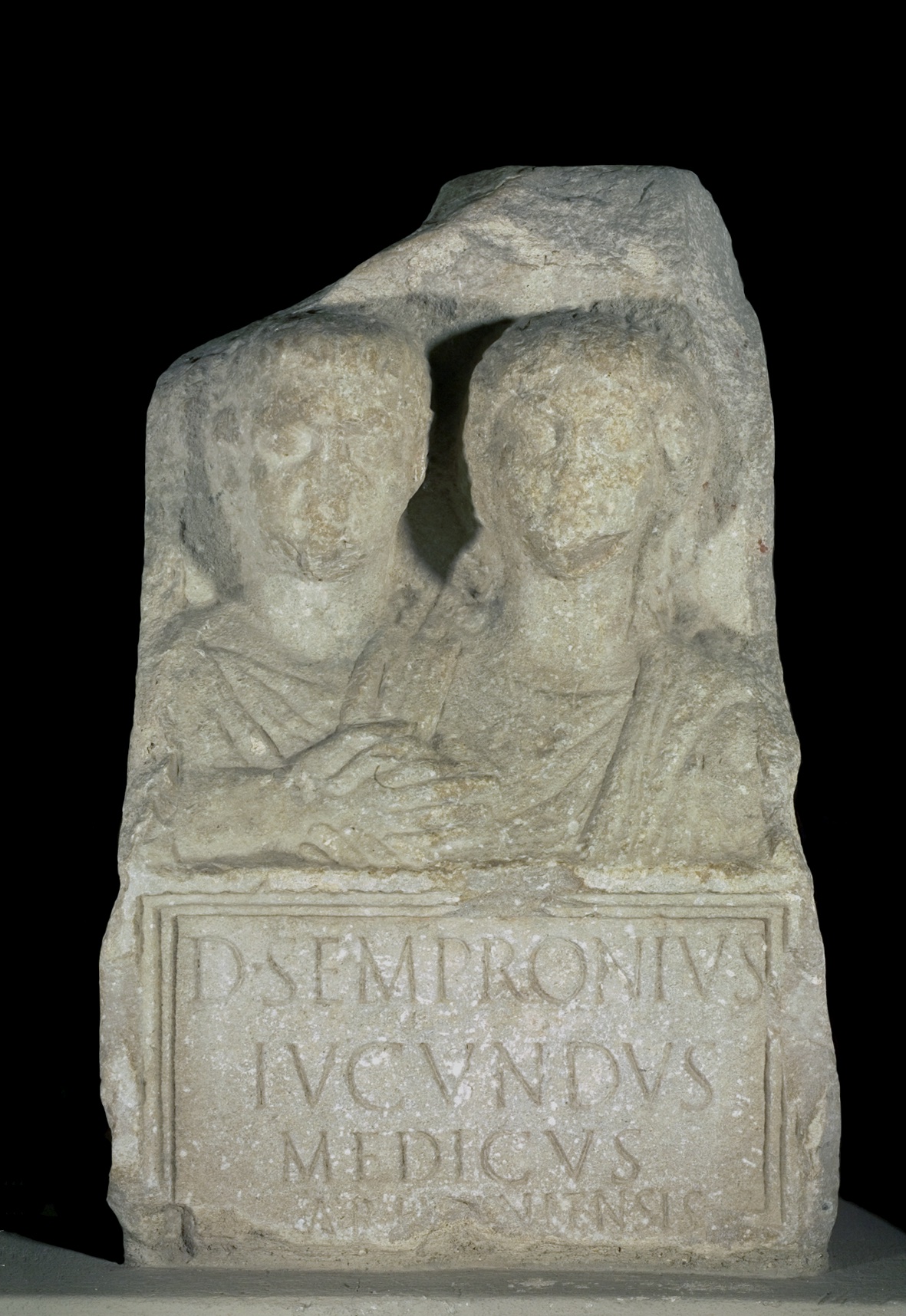
The aedicule stele, dating from around the mid-1st century AD, depicts a married couple performing the dextrarum iunctio, the handshake that in the Roman world sealed the union between husband and wife. However, we know the identity of only the husband: he is Decimus Sempronius Iucundus, a physician originally from Rimini. The man shares the name and profession of Decimus Sempronius Hilarus, the physician commemorated on the pine-cone-shaped funerary monument. Furthermore, the surname Iucundus represents a sort of Latin translation of the Greek Hilarus, both terms corresponding to the Italian ‘cheerful’. It is therefore likely that Iucundus was a freedman (that is, a freed slave) of Hilarus, that he had learnt the principles of medicine from him, and that this close bond led him, after his master’s death, to commission his funerary monument.